

Annual paid subscriptions are on sale for summer! As the left leans right, and the anti-feminists come out in droves, becoming a paying subscriber to this independent feminist newsletter is more meaningful than ever. Thanks for your support!
In recent years, women have been told by commentators across the political spectrum to stop complaining about parenting. Indeed, women are supposed to “fight like hell” (rather than take Tylenol!) through all aspects of the maternal experience, not just the dangerous fevers of pregnancy. Suffering and sacrifice have long been the mark of a good mother, while complaint has long been understood as the mark of a bad mother.
We are to understand a woman’s noble suffering and sacrifice, her ability to buck up and take it, in fact, as the path to maternal power and transformation— a test of our moral, spiritual, physical, and ethical strength, and a process by which women are made whole, and good.
In truth, most people just don’t much like women complaining. The same is true for how so many receive women’s complaints about heterosexuality today— which is to say, women’s feelings about their relationships with men in this intense and deeply fraught time. As women quite understandably tire not only of childbearing and raising children in unequal and unsupported environments, but of dating, marriage, and the shitty behavior of men, women’s disaffection has been put under a microscope.
What are people even seeing? Many straight women are politically, socially, and existentially exhausted by men of a certain age. Such women are disillusioned by patriarchy, misogyny, but also, more specifically, by how those systems play out on the individual level—such as how grown men were socialized in recent decades, and what that now means for men and women’s abilities to have meaningful, caring, and equitable relationships.
As a result, women are, as so many recent essays would have it, afflicted by the disease of heteropessimism. Just this week, another wave of such claims popped up in several places at the US paper of record.
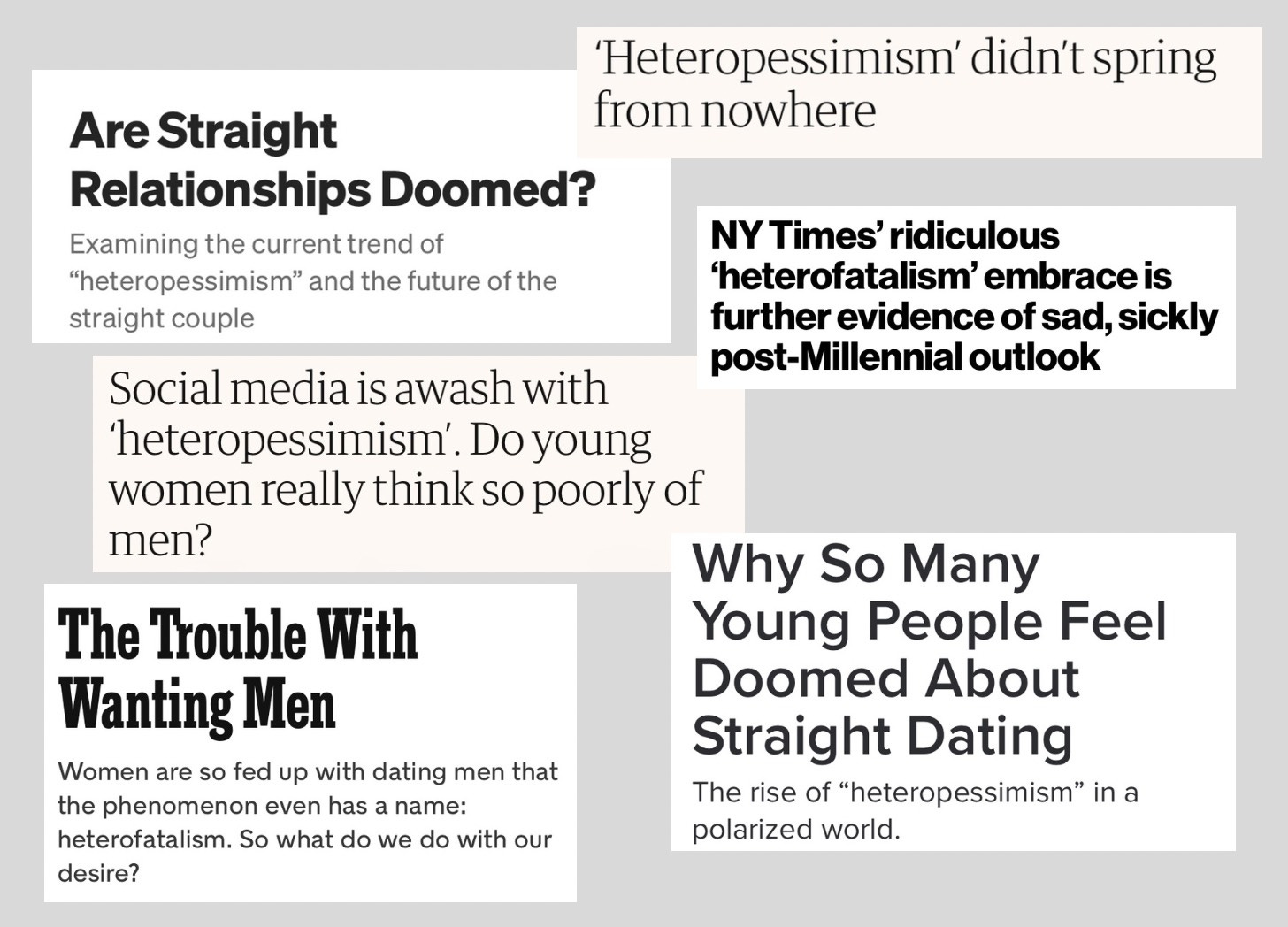
The term heteropessimism, you probably know by now, was originally coined in 2019 by heterosexuality scholar Asa Seresin, to explain “performative” behavior exhibited by straight people, such as poking fun at their straightness to distance themselves from heterosexuality, without actually changing anything about how they relate to heterosexuality’s features and institutions. (Later, Seresin revised the term to “heterofatalism.”)
“Heteropessimism consists of performative disaffiliations with heterosexuality,” Seresin wrote in the now oft-cited essay in which the term was popularized, “usually expressed in the form of regret, embarrassment, or hopelessness about straight experience.”
Use of the term has exploded in recent years, as many seek to explain the gender divide that has revealed itself, especially among young people. The term is useful, complex, and the original essay in which it appeared is smart and rich, tugging on histories of emotion and cultural attachment plotted by writers like Lauren Berlant in feminist and queer theory. It certainly makes sense that many have gravitated to this academic term as shorthand for women’s general unhappiness with heterosexual norms.
But I also think the term has become so popular because something is afoot in the waters of straight culture, and no one is quite sure how to describe what’s happening. (This is the project of a certain podcast that confronts straight culture and politics head on.) I also fear that lately the concept of heteropessimism, once useful and illuminating, has become so watered down that many now simply evoke it to signal— and wave off— nearly all forms of women’s discontent, whether such feelings are shared amongst close friends at dinner, in comical or critical online content, or in reported or personal writing.
The context, in such discussions, no longer seems to matter. Women’s complaints are boiled down to a false equivalency, in which the very real harms of men’s violence, exploitation, and abuse (interpersonal and systemic) are characterized as merely the inverse of feminism.

Many of the thoughtful nuances of Seresin’s original argument have been lost in this widespread, loose application, as have meaningful feminist critiques of the concept, such as those that grapple with the notion of performativity. Yes, “heteropessimism generally has a heavy focus on men as the root of the problem,” but this does not make even the most performative heteropessimists “insincere” in their attitudes.
Seresin pointed out that, obviously, “women are not the only heteropessimists,” citing men who complain about their nagging wives, but also incels, as prime and ubiquitous examples, usually of the “funhouse distortion of feminist complaint” variety. In the latest spate of women are too negative/mean takes, the fact that women grow up hearing and internalize men’s complaints about them (and indeed witnessing the structural execution of those complaints) also disappears from view.
Seresin pointed out that, yes, heterosexuality kills— that is, white men kill. This is happening in plain sight every day.
Even so, recent takes on heteropessimism have been almost exclusively trained on women— on that funhouse characterization of women who gripe too much about the men they date or marry, whether because of their excessive commitment to politics, to work, to their own high standards, or just because these women allegedly lack compassion and good sense and a real commitment to gender equality.
It’s all part of this broader backlash, in which some claim that Me Too and Black Lives Matter and trans rights went too far. We see it in Zuckerberg’s push for a more masculine workplace. In this administration’s total lockdown on critical thought and history and education and their rollback of rights. And in the Democrats’ hand-wringing over how to capture the white male vote.
Just as mothers who wrote honestly about their experiences of parenting after the pandemic were told they were making poor young women feel like there is nothing valuable about having children, now women who complain about the fraught dating scene, or the continued inequities of marriage, are routinely characterized as the cause of such regressive policies—and to boot, these women are frequently characterized as resentful of their own poor life choices, as incapable of love and hope, and as making life unbearable for young men.
A familiar blame the feminists/women/manhaters logic is at work here. In this formulation, the manosphere—ever rooted in complaints about women and feminism—was somehow created by women griping to their friends about their disappointments with men.
Which is to say, critiques of women’s supposedly negative attitudes toward men and straightness are often heteropessimist themselves! They can even feel eerily similar to beliefs shared in groups like Men Going Their Own Way, a group that Seresin says itself claims “that heterosexuality is wholly beneficial to women and severely dangerous for men.” These are critiques rooted in fears that women’s equality and full participation in society simply cannot be endured by men without some violent revolt by men, or with constant caretaking on the part of women.
These assumptions only further feed the idea that women’s expressions of discontent must always be couched not only in positivity, but in performance, purpose, even a kind of political strategy. A woman’s personal feelings, her conversations with friends, her very subjectivity, her experience of intimate relationships in a rape culture, from this perspective, are always to be moralized, analyzed, understood by how they affect the imaginary male other in the room. And she had better be sure, if she shares such feelings publicly, that her framing is pitched for an imagined male audience!
At the same time, men’s behavior gets a kind of personal-is-political pass. It’s as if we say, yes, heterosexuality is political, but only for women. Only women must treat their relationships as such, because men clearly simply cannot bear it with any grace. They cannot bear the accountability and agency women must command at all times.
Critiques of women’s complaints also dismiss the very nature and value of those complaints.
A failure to distinguish the genres and shapes of female and feminist complaint has long plagued contemporary conversations about motherhood. This is, no doubt, a symptom of an online culture in which many are quick to have an opinion about the latest trend or term, and in which everything is boiled down to its simplest form, the responded to in kind. My unpopular opinion: everyone has too many opinions.
But this widespread grumbling about women’s attitudes and supposed social or even online behavior (as if they are all the same exactly)—often in exchange for a “what about the men”/”men are in crisis” mentality—is also a symptom of the current backlash against feminism.
What does a feminist backlash look like, if not judging women’s delivery more harshly than the content of their complaints?
Women have always gossiped and shared information to keep themselves safe. Complaint, in and of itself, has value. As feminist philosopher Sara Ahmed writes in her book on the subject, Complaint!, there is a long history of women’s complaints not being heard. Often, when complaints are shared among women, what we are looking for is simply what Ahmed calls a “feminist ear.” But to hear any complaint, the listener has to “become attuned to the different forms of its expression.” They have to care enough to listen thoughtfully. Ahmed writes that even “frustration can be a feminist record.”
When we substitute a careful understanding of the broad spectrum of women’s emotions with a critique of women’s delivery, or with a knee-jerk re-centering of men, we also miss that heterosexuality, and relationships between men and women, are not only a subject that concerns boys and men, but girls and women—and in fact all of us, of every gender. We miss that complaints about heterosexuality might not only be complaints about men we know, even when they are indeed framed as such, but of the world in which we live, date, love, marry, and fuck— the very content of our lives. We miss the opportunity, quite simply, to hear what it is women are saying.
Heteropessimism, in its original formulation, can make heterosexuality appear to be a “personal problem,” when it is never thus. “Collectively changing the conditions of straight culture is not the purview of heteropessimism,” Seresin wrote.
But many straight women today are renegotiating the terms of their lives, rejecting the social roles and scripts of heterosexuality. Arguably, if men are “in crisis,” this is why— because the terms of relationships with women have changed, for the better, and they do not yet know how to function in response.
Yes, social media remains a breeding ground for a certain brand of heteropessimism, such as essentializing claims about both men and women, weird brands of self-help meant to help women navigate patriarchy without questioning it, and a million strange genres of unhappy straight marriage content, each of which are rich texts unto themselves. But not everything called heteropessimist today has the “anesthetic” or “anticathartic” quality that Seresin originally pegged to the term. Much of it has what Berlant called the effect of an “intimate public”—gestures through which women create a sense of belonging and recognition. Complaint is very often how people feel understood and connected.
These nuances matter, and are where we should look, rather than take up the bro-caster method of pontificating about whether women should be allowed to complain at all.
Some women are earnestly trying, for instance, to reject and change the norms of straight culture. It can often be hard to distinguish the difference between the system and the individual, since we’re all enmeshed in systems. But by discounting any feminine complaint that is not perfectly pitched as dude-friendly systemic analyses, we run the risk of doing what we’ve always done, culturally and politically— ignoring women’s voices altogether.
Ahmed again, in her book: “To be heard as complaining is not to be heard.” And to be heard complaining about men is not be heard as speaking about one’s own life.
Seresin supposed that “radically transforming heterosexuality might begin with honest accounts of which elements of heterosexuality are actually appealing—the house is clearly on fire, but is there anything worth saving?” I agree. I also think this more “positive” approach, as with the problems of “care feminism” today and misinterpretations of “sex positivity,” runs the risk of slipping into policing women who are sounding the alarm on rising authoritarianism and misogyny, and painful political differences between men and women.
As my friend and pod co-host Tracy Clark-Flory has written, the problem is rarely that straight women don’t love men enough, but that we have spent our lives loving them too much— making homes and beds with men who have been socialized to have contempt for us, or to exploit, oppress, or pathologize us, and who do not to see, listen to, or value us.
Some feminists have argued that putting down the caring labor women have long tended to do in relationships with men is a key tactic of breaking away from heteropessimism. To think of heterosexuality, then, not as a “terminal diagnosis,” as Seresin put it, but as a “site of experiment and change,” seems to be precisely what so many straight women are trying to do today. Unfortunately, they are also finding that not many men are willing to join them in this project.
Thanks for putting words to so much of what I'm seeing out there. I wouldn't have known how to describe it myself. But it's incredibly meaningful.